My friend, colleague, and fellow Mexican Intellectual, Frank Gaytan, wrote recently about the behavior of writing and referenced a piece
from The Atlantic that discussed the connection between writing and running. No sooner had I shared with him
that article that he shared with me an op-ed from The Chronicle of Higher
Education. Regular readers know that I have written before. They know also that I have written about
the scholarly purposes that inform why some academics begin a blog and take such care with it. In the “3 Rules for Academic Blogging,” however, David Perry, associate professor of history at Dominican
University, provides some practical advice of why academics should continue to
blog, much of which is relevant to my own – and I think Frank’s - efforts. In discussing “Rule 3: Write for the sake of
writing,” Perry states “Today, a blog becomes a piece of the conversations you
are already having on social media. You
are most likely to use a blog to preach to choirs and attempt to convert the
already converted. But it’s fun to
preach to the choir.” I would add also,
it does not hurt to try to convert the unconverted. After all, a free exchange of flowing ideas
was one of the promises the Internet offered.
It is in this spirit I wish to share the following experience.
Recently, I have been preoccupied with the issues of racism and free speech developing on some of the nation’s college campuses. The highest profile of these events occurred at the University of Missouri and at Yale University, the latter of which coincided with Halloween. Indeed, much of what occurred at Yale began with a discussion about the potential of racially insensitive Halloween costumes. While Yale students argued with administrators about racial insensitivity, the President of the University of Louisville took matters to an entirely different level, posing for a photo with other administrators and staff all deck out in sombreros, serapes, and handle-bar mustaches as they attended a Mexican-themed costume party. In the wake of the backlash and protests the photo engendered, President James Ramsey publicly apologized and vowed to improve the racial climate on Louisville’s campus. One way he vowed to do so was to “[r]ecruit more Hispanic and Latino/a for faculty, staff and administrative positions.” Another was to “[a]dvance efforts to build Hispanic and Latino/a scholarship and financial aid” for students.
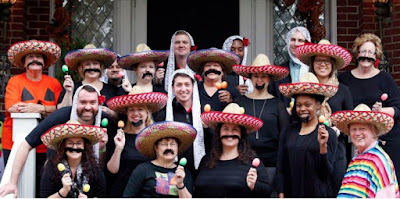
Photo from and available at Latino Rebels
Seeing this story in a news outlet I follow on Facebook, I opined:
Recently, I have been preoccupied with the issues of racism and free speech developing on some of the nation’s college campuses. The highest profile of these events occurred at the University of Missouri and at Yale University, the latter of which coincided with Halloween. Indeed, much of what occurred at Yale began with a discussion about the potential of racially insensitive Halloween costumes. While Yale students argued with administrators about racial insensitivity, the President of the University of Louisville took matters to an entirely different level, posing for a photo with other administrators and staff all deck out in sombreros, serapes, and handle-bar mustaches as they attended a Mexican-themed costume party. In the wake of the backlash and protests the photo engendered, President James Ramsey publicly apologized and vowed to improve the racial climate on Louisville’s campus. One way he vowed to do so was to “[r]ecruit more Hispanic and Latino/a for faculty, staff and administrative positions.” Another was to “[a]dvance efforts to build Hispanic and Latino/a scholarship and financial aid” for students.

Photo from and available at Latino Rebels
Seeing this story in a news outlet I follow on Facebook, I opined:
If Louisville's President wants to make amends for offending Mexicans, shouldn't he strive for more Mexican representation among faculty, students, and staff specifically instead of more Latinos generally as his press release states? Such a declaration still demonstrates a lack of cultural awareness by assuming all Hispanic and Latino groups are the same, which they certainly are not.
My comment struck a chord with some people. As of this writing, 14 people, all of them
complete strangers to me, “Liked” what I said to this shared post. My comment also garnered replies from others,
also complete strangers to me. Most of
them, however, overlooked the point I made about differences among Latino and Hispanic
groups to discuss costumes in and of themselves. I say most because at least one person took exception
to my idea, writing:
So you're saying some...Hispanics /Latinos are not the same? So you think you are better than what? Your opinion does not represent the majority because even Latino Public Figures state Latinos/Hispanics we are all the same one language, one culture here in USA...struggling for the same American Dream. I'm not sure how intellectual or scholarly etcetera you pretend to spill but I know one principle for sure...to a white you are a pinche...Latino/ Mexican no matter where you came from...period. And they see you as a threat at many levels. ...economic power, political, community based, state, and the National/and Judicial level...they know...we will chip away at intolerance, institutional racism, and some now realize that the new generation of hispanics/Latinos are becoming leaders of this great nation and play a key role in its future [sic in toto].
Not wanting to reply in the heat of the moment, I let what
this person said sit for a while, rereading what I wrote and what he wrote
several times to ensure the clarity of the point I was making and to find the
basis of his reply. I considered letting
go of the entire matter, but after several hours I replied with the following,
addressing him by name (which has been redacted):
You don't know me, you don't know the first thing about me, so please do not try to force your orthodoxy on me like some kind of school yard bully. I did not say anyone was better than anyone else, I said we are different from one another. Mexicans, Cubans, and Puerto Ricans - the three largest Hispanic and Latino groups - have different historical and cultural heritages that should be acknowledged and celebrated. They also have different paths to how they got to the United States, have different reasons for being here, and have different citizenship statuses among them. The case is similar among other Latin Americans in the US. There is nothing wrong with differences among people. It is also known as diversity, which is an idea most progressives like me champion. Hispanics and Latinos saying all Hispanics and Latinos are the same only makes it easier for white people to say we are all the same and gives white people their justification for discriminating against us in all the same ways. This is all I will say about this as I have no desire to get into a flaming war with a complete stranger. I wish you well.
I have written before about this issue, most notably here
and here. As an academic, ideas are
important to me. As an historian, ideas
of how the past informs our present are no less so. On one hand, I feel a tad guilty responding
to another's idea and then cutting off that interaction. On the other, however, I feel worst about
circumstances that made me feel that I had to cut off the interaction out of
some sense of self-preservation in light of such a vulgar ad hominem. It is difficult to conduct reasoned and
rational discussions about important issues on-line or in person when emotions run high and passions are inflamed.
I wonder, if not worry, about the chilling effect on discourse and
problem solving that the current temperature on some college campuses will have
in both the short- and long-term.
I hope cooler heads will prevail.
I hope cooler heads will prevail.

